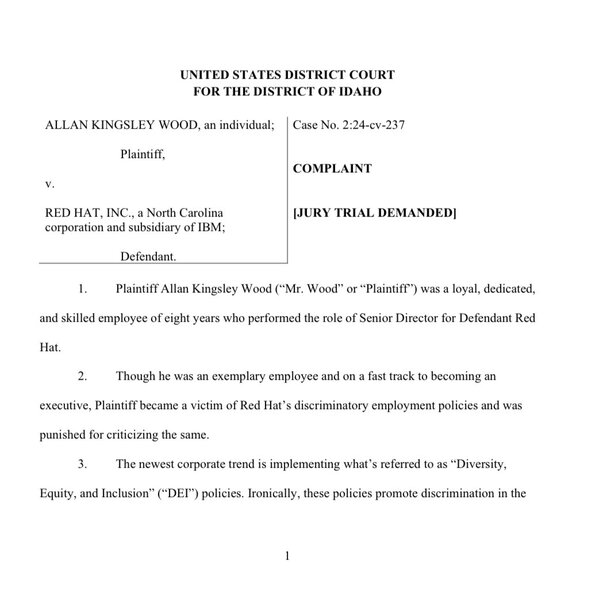
Now, a lawsuit has been filed against Red Hat, on behalf of Allan Wood, who was a Senior Director at the Linux giant.
That lawsuit alleges significant racial, relgious, and gender discrimination. And, based on what information we currently know about Red Hat's discriminatory policies... his case looks incredibly strong.
We just filed a federal lawsuit against IBM’s subsidiary Red Hat for illegal racial discrimination. IBM has allegedly implemented illegal anti-white and anti-male quotas. We will use every tool to hold IBM accountable:
With our co-counsel, including Barnes Law, we filed a lawsuit on behalf of our client against the International Business Machines Corporation’s (IBM) subsidiary, Red Hat, for violating Civil Rights laws by allegedly engaging in discriminatory employment and termination practices against white males.
Our plaintiff is a white male and was a dutiful Red Hat employee for eight years, rising to the position of Senior Director. He was an exemplary employee who had never received a negative review during his time at Red Hat.
But for the discrimination he faced, he was on the path to becoming one of the top executives at Red Hat…
In 2021, Red Hat began implementing illegal diversity, equity, and inclusion (DEI) requirements. In accordance with its illegal activities, Red Hat hired a Chief Executive Officer of DEI to spearhead these programs — mandating employee training while implementing employment quotas aimed at achieving diversity goals by illegally treating race as a dispositive factor for employment and advancement.
On several occasions, managers and executives at Red Hat commented to our plaintiff and other employees expressing their dismay at the lack of diversity in the workforce and their desire to achieve certain workforce quotas based on race and gender. Red Hat executives indicated that these DEI initiatives would influence certain hiring and employment decisions.
Our plaintiff was vocal about his opposition to these discriminatory policies and continuously advocated for hiring based on merit and skill rather than other immutable characteristics.
Red Hat made express statements, both vocally and in writing at company events, that were derogatory towards white individuals and presented an anti-white agenda. Red Hat also remarked on the low number of women employed and expressed anti-male rhetoric. Red Hat made it clear that it was going to implement heightened DEI policies, with the sole intent of increasing diversity.
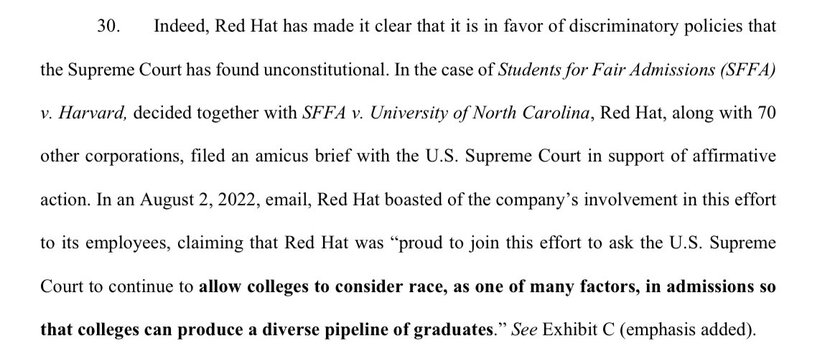
Red Hat has made it clear that it is in favor of discriminatory policies that the Supreme Court has found unconstitutional.
In the case of Students for Fair Admissions (SFFA) v. Harvard, decided together with SFFA v. University of North Carolina, Red Hat, along with 70 other corporations, filed an amicus brief with the U.S. Supreme Court in support of affirmative action:
At a kickoff event in Texas, Red Hat brazenly announced its “Bold DEI Goals,” which included quotas.
Red Hat sought to remake its workforce demographic, seeking to reach 30% women globally and 30% associates of color in the United States by 2028.
Just two weeks after this announcement, our plaintiff was informed by his manager that his role was being eliminated following several months of discriminatory treatment.
Upon information and belief, 21 of the total 22 individuals were white males.
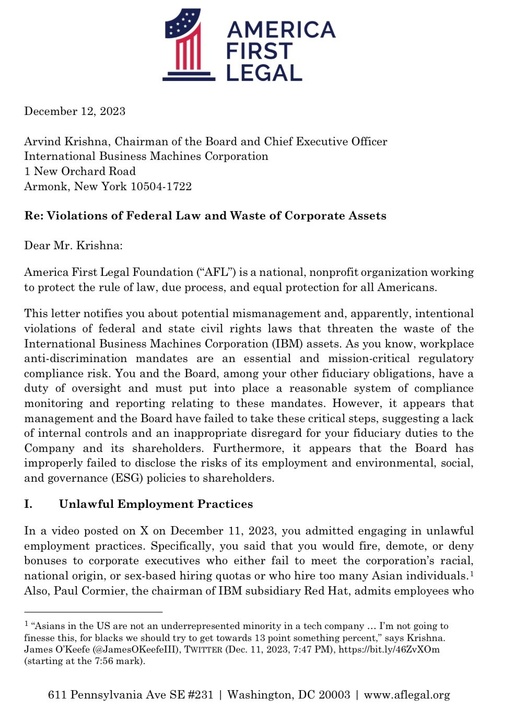
Last year, James O'Keefereleased a recording of IBM Chief Executive Officer and Board Chairman Arvind Krishna promising to fire, demote, or deny bonuses to corporate executives who fail to meet the corporation’s racial, national origin, and sex-based hiring quotas or hire too many Asian individuals.
Following this shocking footage, we filed a federal civil rights complaint with the EEOC against IBM for alleged racial and sex discrimination.
We also wrote to IBM’s Board of Directors, demanding an end to the corporation’s systemic violations of law to prevent the waste of corporate assets and harm to shareholders.
Today, we are proud to file this lawsuit to continue to fight corporate America’s destructive, illegal, and odious use of illegal DEI initiatives that are fundamentally anti-white, anti-male, and anti-equality.
The GNOME Foundation is in total meltdown, attacking their own members, along with hardware companies (Framework), Open Source projects (Omarchy, Hyprland, others), and even... JK Rowling and Charlie Kirk?
Ads are filling the entirety of the Web -- websites, podcasts, YouTube videos, etc. -- at an increasing rate. Prices for those ad placements are plummeting. Consumers are desperate to use ad-blockers to make the web palatable. Google (and others) are desperate to break and block ad-blockers. All of which results in... more ads and lower pay for creators.
It's a fascinatingly annoying cycle. And there's only one viable way out of it.
Want to do even more to help out? Grab a “pay what you want” Lifetime Subscription and get your name in the “About This Computer” window inside LCOS 1.0! These funds go directly towards hardware testing and other expenses.
Huge thank you to everyone who has contributed with both hardware testing and financial support. We’ve had absolutely tremendous momentum over the last few months, and that wouldn’t have been possible without all of you.
A huge thank you to everyone who has already contributed (in both ways)! With your help, we are making LCOS into the best gosh darned system in all the land.
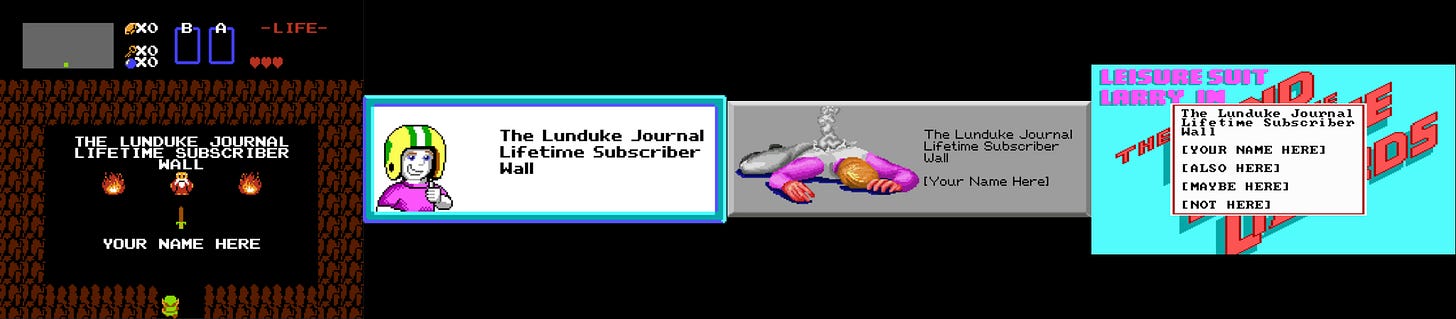
Lunduke Lifetime Discount Ends in 1 Day; Zelda, Larry, SQ, & Keen Walls Available
TL;DR: Lifetime Subscription discount ends in one day. There are currently 4 “Lifetime Walls” with space available for more names (the Oregon Trail Wall is now full).
We’ve been running a massive discount on Lunduke Journal Lifetime Subscriptions for the entire months of June and July. And it has been an absolute blast. There are now 21 (twenty-one!) retro computer walls overflowing with your names.
Pure insanity. Huge thank you to everyone who has supported The Lunduke Journal.
But the discounted price only runs through July 31st… and that moment is just about here.
When the calendar ticks over into August (just a hair over 24 hours from now), the Lunduke Journal Lifetime Subscription price goes back to normal.
If the calendar still says it’s July, the Lifetime price is still discounted to $125.
If the calendar says August… the price returns to $300.
There are, as of this exact moment, 4 retro game themed “Lifetime Walls” which still have some space for more names (check Lunduke.com for the full list):
Legend of Zelda
Commander Keen 4
Space Quest 4
Leisure Suit Larry
Grab a discounted Lifetime Subscription (scroll down for the details), then email Lunduke (bryan at lunduke.com) with which Wall you’d like to appear on.
First come, first served. Once a Wall is full, it’s full. So if there’s a specific Wall you’d like to be on, don’t dilly dally.
How to Grab a Discounted Lifetime Subscription:
There are 3 different ways to pick up a Lunduke Journal Lifetime sub. All of them work great. Choose whichever works best for you!
Remember: These discounted prices go back up to normal ($300) on August 1st.
Send $115 worth of Bitcoin (or more) to the following address:
bc1qyjakve8fywm8pz2v99v57yhjj0vzr2vjze6fcq
Email “bryan at lunduke.com” with the following information: What time you made the transaction, how much was sent (in Bitcoin), and the email address you use (or plan to use) on Locals.com or Substack.com.
There are some options. For both subscribing and donating. They're all on this page.
Bonus: At the bottom of this page you will find the invite link to the super-secret Lunduke Journal Discord Chat Server. This is only available for full subscribers, which makes it a nice place to hang out. No riff-raff.
Only for Supporters
To read the rest of this article and access other paid content, you must be a supporter